Caeau
Ennyd
WRITINGS 01
WRITINGS 01
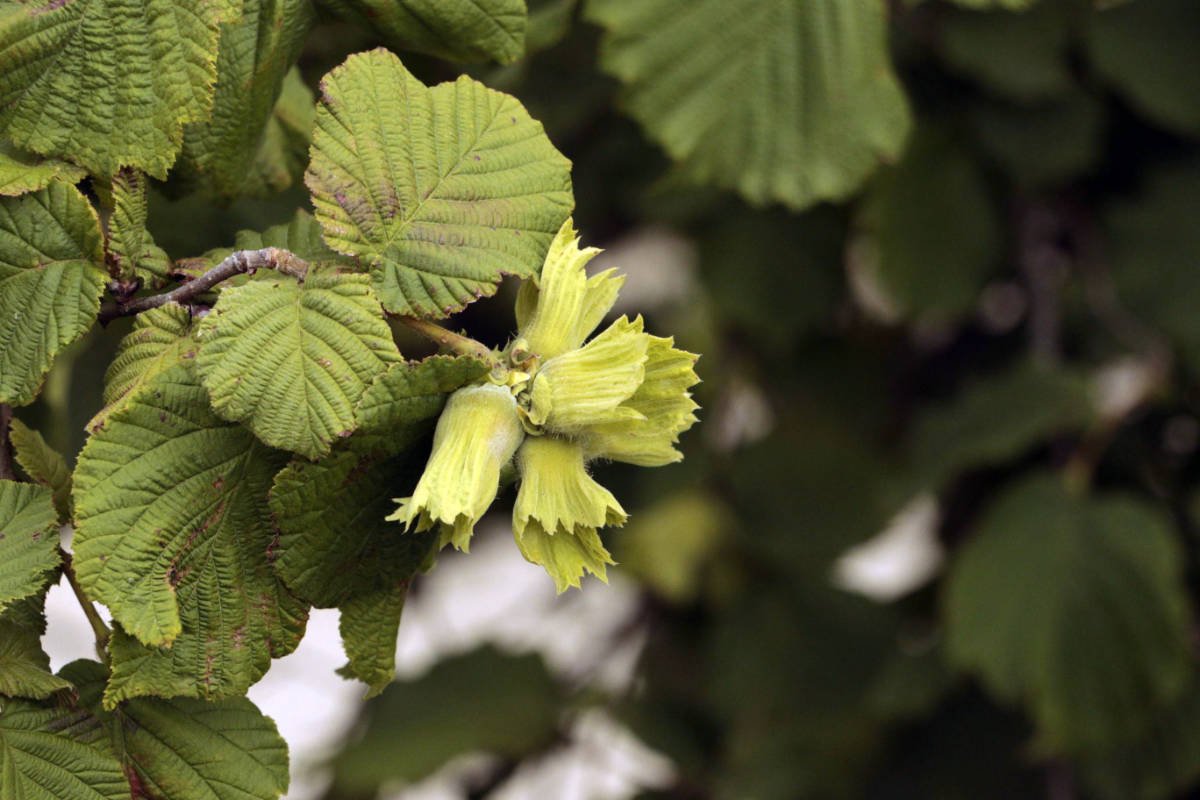
THE HAZEL, with her little white catkins dancing to the whisper of the leaves beneath the spell of the breeze — who among us doesn’t have a special place for this ancient tree? Who doesn’t have sweet memories of the sheer delight of discovering those little green nuts, just beginning to show their faces between the rounded leaves that have been carefully guarding them from the hungry eyes of us all?
My first memory of Y Gollen is of going down to play in Cwm Bowydd, (Blaenau Ffestiniog), with the nuts playing hide and seek with us. Well, obviously, we had to have a go at collecting them and having a feast. Picking up a twig or a stone from the ground and try to knock them down, and then learning that a better technique still was to climb onto each other’s backs beneath the branches and look up…..then there was no hiding for them.
Afterwards came the fun of trying to get them out of their shells….putting one between the back teeth of my mouth and cracking it open (doing absolutely no good whatsoever to my teeth!). That is, until I got a sour one, and very quickly learned that the best way was to crack them under a stone on a nearby piece of slate ....so much better than trying to crack one beneath your foot, where mud was almost certain to find its way onto the cneuan (nut) before we did!
Oh! The sheer delight of the taste, trying to collect as many as possible to take home. Ridiculously eager, almost greedy, without giving a thought to all the other creatures who were wanting to collect them too, and who needed them far more than we did. The excitement of finding and picking up the fallen ones, collecting the green ones, going home with a fair crop and yn gwenu fel giat (with a smile from ear to ear).
Then, over the following days, discovering that many of the green ones were no more than the size of a little fingernail, while most of the fallen ones were rotten or had already been eaten by some other little creature. Er hynny (despite that), it was fun and games every year afterwards.
This wasn’t only the beginning of a lovely tradition for me, but the first step in years of learning about Y Gollen. Apparently, she was one of the first trees to grow back after the Ice Age, before the Bedwn (Birch) and the Derwen (Oak) took her place. This was because she's a tree that grows best in low-nutrient soil. Give her soil that is too rich and all that goodness goes into her leaves rather than her flowers and nuts.
Being one of the first trees to return after the Ice Age, there is a wonderful variety of legends and symbolic meaning attached to Y Gollen. She is believed to bring wisdom, peace, fertility and sustenance, although some consider her unlucky.
Now then, we know that finding double nuts is considered very lucky, but did you know they were also handy for frightening gwrachod (witches) away? If you came across a double cneuan, all you had to do was throw it at the gwrach (witch) and off she'd scuttle.
Dreaming about cnau cyll (hazelnuts) foretells the discovery of treasure. And if you wanted to remind an old lover that they had been rejected, the old tradition of the White Wand was the one for you! On your wedding day, you would send a piece of hazel wood with the bark removed, sometimes with a black ribbon tied around it, together with a note reminding them that they were not the one for you! There are records of this happening in Montgomeryshire as late as the 1920s, with some even being sent through the post!
There are many gods associated with Y Gollen: Aengus, Artemis, Diana, Hermes, McColl, Mercury and Thor. I should also mention Saint Collen, and his connection with Llangollen way back in the seventh century. He died on May 21st or 22nd, and his feast day was kept on the same date, which is why the Llangollen fair was held on that day (the 31st after the change from the Gregorian calendar to the Julian method of counting).
I wonder whether this too is why Y Gollen became associated with the star sign Gemini (May 22nd to June 21st) …or is that a complete coincidence?
But enough of that for now. What about looking at her name…. Y Gollen. I mentioned earlier that some people see her as unlucky, with Celtic superstition connecting her with loss and harm. So it is rather curious that Colli (to lose) or Coll (lost) sounds so similar to some of the old Celtic names for Y Gollen:
Gaelic/Irish: Calltuinn, Calldainn, Colluin.
Cornish: Col Widen.
Manx: Coll.
Gaelic: Coill.
But then, perhaps it isn’t quite so strange when you consider the following:
coll + -i, which corresponds with the Latin clādēs — destruction — and the Old Irish coll — destruction.
Interesting, isn’t it!
It’s also interesting that the English form Hazel comes from the Old English Haesl, meaning power rod.
Although Y Gollen grows all across Wales, and is ancient at that, there aren’t as many place names connected with her as you might expect. I know of the following — do you know of any more?
• Berllan-gollen, Glamorgan
• Llangollen, Denbighshire
• Nant-y-gollen, Shropshire
• Allt Ffynnon-gollen, Carmarthenshire
• Allt Nantygollen, Carmarthenshire
• Coed y Gollen, Glamorgan
• Coedlwch Cwrt-y-Gollen, Monmouthshire
• Cwm Llangollen, Denbighshire
Y Gollen grows quite quickly, around 40–60 cm a year, reaching a height of around 12 metres, and normally lives for about 80 years. Unless, that is, she is regularly coppiced — then she can live for hundreds of years.
In the past, her wood was widely used for all sorts of things, from spears to bows, baskets, fences, staffs, wands, walking sticks and fishing rods. It seems very likely that this has been going on since time immemorial. There is a record of a fishing rod made from hazel dating as far back as 2,000 years before Christ.
She makes good charcoal, and you can make black powder when finely ground charcoal is mixed with the right amounts of sulphur and saltpetre….but I certainly wouldn’t recommend anyone doing that!
Because Y Gollen throws out quite a lot of new young growth, she is good for protecting the land against water erosion. Once coppiced, she also provides a cosy habitat for ground-nesting birds such as the Eos (Nightingale), Cyffylog (Woodcock), Bras Melyn (Yellowhammer) and Thelor yr Helyg (Willow Warbler).
Quite a few animals enjoy her cnau — y wiwerod (squirrels), y llygod mawr (rats), llygod maes (field mice), and especially the pathewod (dormouse).
The nuts are also enjoyed by birds such as Cnocellod (Woodpeckers), Titwod (Tits), Colomennod y Coed (Wood Pigeons), Deor y Cnau (Nut Hatches) and Sgrech y Coed (Jays).
The trunks are often covered in moss, liverworts and lichen. Several species of Graphidion lichen depend upon her, and there are 21 different types of fungi that have a good relationship with Y Gollen.
There are also quite a few insects who are fond of her leaves, such as the larvae of Craesus septentrionalis and the leaf miner Parornix devoniella.
The cneuan itself is extremely nutritious, containing around 15% protein, 60% fatty acids, vitamins including vitamin E and B6, zinc, iron, calcium, potassium, selenium and magnesium.
We use cnau cyll oil in products for our skin. We also have a tradition of drinking hazel-leaf tea for colds and to help control heavy menstrual bleeding. The tea has also traditionally been used to treat wounds, because it is astringent.
The leaves were used to make a spicy pork soup called Noteye in the Middle Ages, and in Slovakia the little white catkins are used to make flour.
There is much, much more to say about Y Gollen, and I’m sure I’ll expand on it another time, but I’m going to leave you for now with my favourite recipe for cnau cyll, which I call CnauEla!
Simple homemade CnauEla
Mwynhewch (Enjoy) ! Xx